
Before we get into the benefits, here’s the honest version: distilled water is not a miracle cure, and it won’t transform your health overnight. But if your tap water is carrying contaminants — and there’s a good chance it is — switching to distilled water can make a real, measurable difference. Here’s what the evidence actually says.
In this article
- What distillation actually removes
- The genuine health benefits
- Who benefits most
- The honest downsides
- Myths worth clearing up
- The verdict
What distillation actually removes — and what it doesn’t
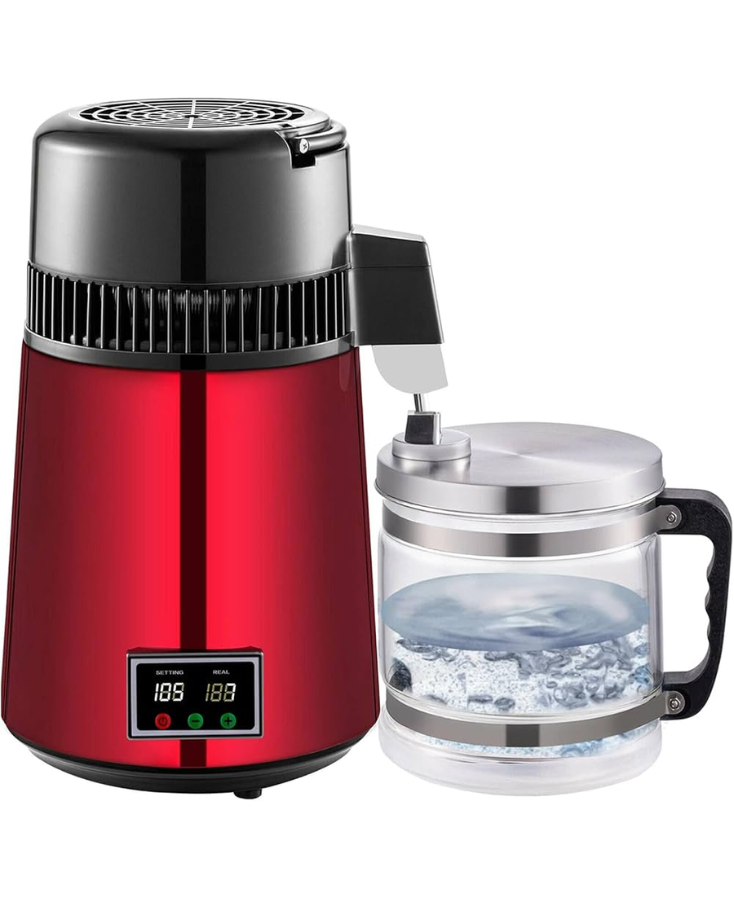
Distillation works by boiling water into steam, then condensing that steam back into liquid. Anything that can’t evaporate gets left behind in the boiling chamber. That includes most of what you don’t want in your water.
Here’s what distillation reliably removes:
| Contaminant | Source | Removal rate | Potential health risk if untreated |
|---|---|---|---|
| Lead | Old pipes, plumbing solder | ~99.9% | Neurological damage, developmental delays in children |
| Arsenic | Natural groundwater, industrial runoff | ~99% | Increased cancer risk with long-term exposure |
| Nitrates | Agricultural runoff, fertilizers | ~99% | Methemoglobinemia (especially dangerous for infants) |
| Fluoride | Municipal water treatment | ~99% | Dental/skeletal fluorosis at high levels |
| Chlorine & chloramines | Municipal disinfection | ~99% | Disinfection byproducts linked to bladder cancer risk |
| Bacteria & viruses | Contaminated wells, aging infrastructure | ~99.9% | Gastrointestinal illness, serious infection |
| Heavy metals (mercury, cadmium) | Industrial contamination | ~99% | Kidney damage, neurological effects |
| PFAS (“forever chemicals”) | Industrial sites, firefighting foam | ~99% | Cancer, thyroid disruption, immune suppression |
One thing distillation does not remove well: volatile organic compounds (VOCs) like benzene or chloroform that have a boiling point lower than water. These evaporate with the steam. A quality distiller includes a post-distillation carbon filter specifically to catch these — if yours doesn’t have one, add an inline carbon filter after the unit.
The genuine health benefits — with the evidence behind them
1. Reduced exposure to lead
This is the most clear-cut benefit, and the evidence is solid. Lead exposure has no safe level — the CDC confirms that even low levels in children cause permanent cognitive damage, lower IQ, and behavioral problems. In adults, chronic exposure raises blood pressure and increases kidney disease risk.
Lead enters drinking water almost entirely through plumbing — old pipes, solder, and brass fittings. If your home was built before 1986, you almost certainly have lead-containing plumbing somewhere between the street and your tap. Distillation removes it nearly completely.
The 2014 Flint water crisis was an extreme case, but lead contamination in home plumbing is widespread and largely invisible. You won’t taste it, smell it, or see it.
2. Lower exposure to disinfection byproducts (DBPs)
Municipal water treatment uses chlorine to kill pathogens — which is genuinely important and saves lives. But chlorine reacts with organic matter in the water to form disinfection byproducts like trihalomethanes (THMs) and haloacetic acids (HAAs). Long-term exposure to elevated DBP levels is associated with increased bladder cancer risk, according to the International Agency for Research on Cancer.
Distillation removes chlorine and the organic matter that forms DBPs. If you’re on city water and drinking it every day for decades, this matters.
3. Safe water for immunocompromised people
People undergoing chemotherapy, living with HIV, organ transplant recipients, and the elderly with weakened immune systems face real danger from pathogens that healthy adults shrug off. Cryptosporidium and Giardia, for example, are protozoan parasites that standard chlorination doesn’t reliably kill — they require UV treatment or filtration. Distillation eliminates both.
For this group, distilled water isn’t a lifestyle choice — it’s a meaningful health precaution.
4. Better water for CPAP machines
If you use a CPAP machine with a humidifier, the manufacturer almost certainly specifies distilled water. Tap water leaves mineral deposits in the water chamber that degrade the machine, reduce its lifespan, and can harbor bacteria in the warm, moist environment. Distilled water prevents all of this. It’s one of the most practical, no-debate use cases for a home distiller.
5. Removing nitrates — critical for infants and pregnant women
Nitrates from agricultural runoff are a serious problem in rural well water across the Midwest and other farming regions. At high levels, nitrates cause methemoglobinemia (“blue baby syndrome”) in infants under six months — a potentially fatal condition where the blood loses its ability to carry oxygen. Standard water filters don’t reliably remove nitrates. Distillation does.
If you’re pregnant, have an infant, or live in an agricultural area and rely on well water, this is not a theoretical concern.
6. Reducing PFAS exposure
PFAS (per- and polyfluoroalkyl substances) are a class of thousands of synthetic chemicals used in non-stick cookware, food packaging, stain-resistant fabrics, and firefighting foam. They’re called “forever chemicals” because they don’t break down in the environment — or in your body. They’re now detected in drinking water supplies across the US, including many municipal systems.
The EPA set new maximum contaminant levels for several PFAS compounds in 2024. Distillation is one of the most effective removal methods available at the household level, achieving roughly 99% removal for most PFAS compounds.
Who benefits most from distilled water
Not everyone needs a distiller. Here’s an honest breakdown of who gets the most value:
Private well users. If you’re on a well, you have no municipal treatment and no regulatory oversight. You’re responsible for your own water quality. The EPA estimates that roughly 23 million US households rely on private wells — and studies consistently find that 20-45% of tested wells contain at least one contaminant above safe levels. A distiller is one of the most comprehensive solutions available.
Older homes on city water. Your municipal treatment plant may be doing its job, but if you have lead pipes or old solder in your home, the problem starts after the water leaves the plant. A distiller solves this at the point of use.
Anyone in a PFAS-affected area. The Environmental Working Group’s Tap Water Database lets you look up your specific water supply. If PFAS are detected, distillation is one of your best options.
CPAP users. Straightforward — use distilled water, extend your machine’s life, and reduce infection risk.
Families with young children. Children absorb contaminants at higher rates than adults, and their developing nervous systems are more vulnerable to lead and other neurotoxins. If there’s any uncertainty about your water quality, distilled water removes the guesswork.
The honest downsides
A fair article covers both sides. Here’s what distilled water doesn’t do, or where it falls short:
It removes minerals. Distillation removes calcium, magnesium, and other minerals along with the contaminants. This is the most common criticism. The counterpoint is that the minerals in drinking water are inorganic and relatively poorly absorbed — you get the vast majority of your minerals from food, not water. That said, if your diet is already mineral-deficient, it’s worth being aware of.
It tastes flat. Many people find distilled water tastes different — sometimes described as flat or slightly hollow. This is because the dissolved minerals that give tap water its taste are gone. Some people prefer it; others don’t. A remineralizing filter added after the distiller can restore a more familiar taste.
It’s slow. A countertop distiller typically produces one gallon in 4-6 hours. For a household of four, you may need to plan ahead or get a larger unit.
It uses electricity. Running a distiller costs roughly $0.25-0.35 per gallon in electricity, depending on your rate. Still cheaper than bottled water, but worth factoring in.
Myths worth clearing up
“Distilled water leaches minerals from your body”
This is the most persistent myth about distilled water, and it’s not supported by evidence. The claim is that because distilled water is “hungry” for minerals, it pulls them from your body. In reality, water doesn’t selectively extract minerals from your tissues. Your kidneys regulate mineral balance far more powerfully than anything you drink. People have been drinking distilled water for decades without mineral deficiency — including in countries where low-mineral water is the norm.
“Distilled water is acidic and harmful”
Freshly distilled water has a neutral pH of 7. It can absorb a small amount of CO₂ from the air and drift slightly below 7, but this is well within the range your body handles without any effort. Your stomach acid sits at pH 1.5-3.5 — a tiny shift in water pH is physiologically irrelevant.
“You need the minerals in water for good health”
The World Health Organization has studied this. Their conclusion: while water minerals aren’t harmful, they’re not a meaningful source of nutrition for most people eating a varied diet. The minerals in water contribute a small fraction of daily recommended intake. Food is where your minerals come from.
“Distilled water is only for laboratories”
Distilled water is used in laboratories precisely because of its purity — which is exactly why it’s beneficial for drinking. The purity that makes it useful in a lab makes it free of the contaminants you’d rather not be consuming daily.
The verdict
Distilled water is not magic, and anyone selling it as a cure-all is overselling it. But as a method of ensuring your drinking water is free from lead, arsenic, nitrates, PFAS, bacteria, and the cocktail of disinfection byproducts that come with municipal treatment — it’s one of the most comprehensive and reliable options available at the household level.
The people who benefit most are well users, people in older homes, families with young children, CPAP users, and anyone whose local water supply has known contamination issues. For everyone else, it’s still a reasonable choice if water purity matters to you — just go in with accurate expectations.
If you’re considering a distiller, the next step is figuring out which type fits your household. We’ve reviewed the most popular countertop and automatic models — see our top picks here.